84 Messages

 • 

1.6K Points

Friday, May 5th, 2023

In Progress

Edit form won’t allow “but” to be lower-case in English titles

The title formatting rules state:

In English titles, most prepositions and conjunctions (of, and, in, for, etc.) should not be capitalized unless they are the first or last word or immediately follow a colon, em dash, or end punctuation.

But when I try to edit an English title to make the first letter of but used as a preposition or conjunction lower-case, IMDb automatically “corrects” it to But. See the green bit of this:
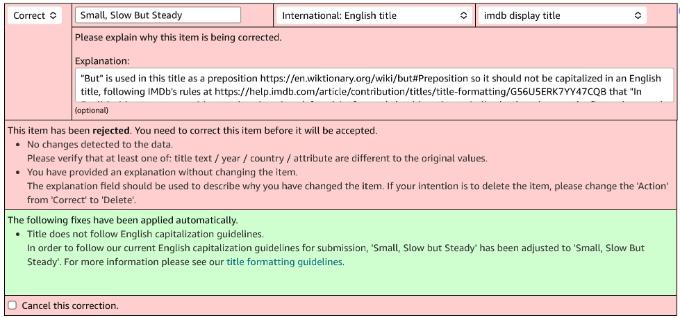
Writing prepositions and conjunctions four or fewer letters long in all lower case does follow the English capitalisation guidelines that the message in green links to. I just quoted the relevant sentence above. This message is nonsense that contradicts itself.
Either the capitalisation guidelines are wrong or the automatic “correction” the edit form makes is wrong. Whichever is wrong needs to be fixed, and I suspect it’s the latter.
The only good thing is that this only affects titles with a Country/Language in the format of “_____: English title”. Ones with just a country name, like “USA” or “UK”, will accept but being all in lower case.
Oldest First
Selected Oldest First

Employee

 • 

18.2K Messages

 • 

321.4K Points

3 years ago

Hi @English_pedantic_grammarian -

Thanks for reporting this contribution issue, I have filed a ticket for the appropriate team to investigate.  As soon as have an update on the status I will relay that information here.

Cheers!

1.7K Messages

 • 

22.9K Points

@Michelle​ I don't think anything is wrong here, title capitalization guidelines say that only these English words must begin with a lower-case letter (unless at the end of a title): a an and as at by for from in of on or the to with

Yes it says "most prepositions and conjunctions" should not be capitalized but in the next sentence it lists which ones are included in detail and "but" is not one of them, so it should not begin with a lower-case letter.

(edited)

Champion

 • 

15.7K Messages

 • 

344.4K Points

Perhaps this is because but can also be an adverb. Even so, it is unusual to always capitalize but in titles. Most occurrences of but are conjunctions or prepositions.

I see that the Guardian agrees, though: "Words in titles take initial caps except for a, and, at, for, from, in, of, on, the, to (except in initial position or after a colon)"

(edited)

1.7K Messages

 • 

22.9K Points

Well, that's the established rule for years. I mean there is no technical or "contribution issue" here, it's in line with the current rules. Michelle's reply indicates she filed a ticket about changing the behaviour of the submission form (not about changing the policy), but as long as the policy remains the same (I think it should just stay as is), there is no need to change the behaviour of the form, because it does what the current rules want it to do.

Champion

 • 

15.7K Messages

 • 

344.4K Points

Even though but is not one of the words that must always be lowercase, I understand that the earlier phrasing "most prepositions and conjunctions (of, and, in, for, etc.) should not be capitalized" may suggest that but should also be lowercase when it has a similar function as those words. If this is not a desired interpretation, the text could be edited, for example by removing "most prepositions and conjunctions (of, and, in, for, etc.)" and instead referring to the list below.

(edited)

84 Messages

 • 

1.6K Points

@mbmb​ Can you point out where the rules state that any prepositions and conjunctions not listed in the rules must start with a capital letter?

I've just reread them, and I cannot find that.

I can see a few examples of prepositions and conjunctions. But I can't find a statement that all other prepositions and conjunctions must start with an upper-case letter.

I can see a longer list of words that must begin with a lower-case letter. But I can't find a statement that all words not in the list must start with an upper-case letter.

As they are, the rules leave it open that some words can be capitalised or not depending on whether they are used as a preposition or conjunction or as another kind of word.

Looking at the rules closely does, however, reveal there are several things very strange about them. Maybe they could benefit from an overhaul in general.

This first line refers to a single title ("the title text", "it"):

When adding the title text (either the primary or alternative), it should follow these rules on capitalization:

But the next line switches to referring to titles in the plural ("they"):

They should not consist of only capitalized letters, even if the title on-screen is fully capitalized. The exception to this rule is if the name itself is an acronym (e.g. R.I.P.D).

"The title on-screen" is an awkward way of describing it; calling it "the on-screen title" would follow the normal English adjective–noun word order.

The title given as an example is wrong. In logos and on the movie's IMDb page, it's R.I.P.D., with a full stop after the D as well as each of the previous letters.

The line I quoted in my opening post mentions an "em dash". But IMDb doesn't allow en or em dashes in titles; it converts them into hyphens. No word can ever follow an em dash because em dashes themselves are forbidden. So why mention words following em dashes and have a rule about it here?

The list of "English language words which must begin with a lower-case letter" ignores that some of these words are used in phrasal verbs, which include (but are not limited to) the list in this document.

For example, in Walk on Wateron is used as a preposition. The water is where the walking is taking place (at least metaphorically).

But in The Night Is Short, Walk On Girl, the title does not refer to people trampling on top of a girl. It refers to the girl walking on, i.e., continuing to walk, which is a verb made up of two words, so both those words should start with a capital letter.

In I Could Go On Singing, go on is used together as a verb. It's not about going on top of singing; it's about going on, and on… And I could, but I'll just point out that it's one of many titles on IMDb that don't follow conventional English capitalisation due to the lack of nuance in IMDb's hard and fast rules.

The rules also don't specify if IMDb follows the rule that prepositions five or more letters long should start with a capital letter (which is common but not universal) nor what to do about words joined by hyphens.

(edited)